






|
What Is Jazz?*
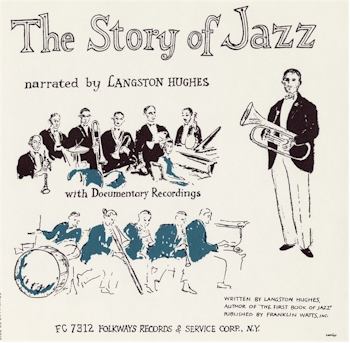
| The Story of Jazz (1954) |
The word jazz has a variety of meanings, encompassing a broad, changing stream of styles. Definitions of jazz tend to be controversial, partly because people hold different concepts of what jazz is and partly because jazz depends on improvisation, which is often very difficult to notate. The inflections in pitch, variations in tone color, and rhythmic nuances in jazz improvisation must be notated in order to describe and define jazz. This has not been done. The changes which have taken place throughout the history of jazz and the existence of many different jazz styles also make it difficult to arrive at an adequate definition. But there are some traits which characterize jazz of several different eras. Two of these traits are improvisation and jazz swing feeling.
IMPROVISATION
To improvise is to compose and perform simultaneously. A great deal of improvised music is spontaneous, unrehearsed, not written down beforehand. Popular synonyms for the verb 'improvise' include ad lib, ride, and jam. Some of the vitality associated with jazz may be due to the spontaneity of improvisation. Jazz musicians are so conscious of spontaneity and originality that they try to never improvise in a given context the same way twice. Several versions of a tune played by a soloist during one recording session may be quite different from one another.
For most people, improvisation is an essential element of jazz, and musicians occasionally use the word jazz as a synonym for improvisation. For example, in a music publisher's brochure describing big band arrangements, a note might be included to the effect that "only the tenor saxophone part requires jazz." Or a musician's contractor might phone a player requesting that he play jazz trumpet chair in a big band, meaning the player will be the only man in the trumpet section required to improvise.
The inexperienced listener may have difficulty in differentiating what has been written or memorized beforehand from what is being improvised. If a performance sounds improvised it quite often is, but the best improvisations are so well constructed that they sound almost like written melodies. Many jazz fans solve the problem by knowing that, in most performances when a tune itself ends, what follows is improvised. It is all improvised until that same tune begins again. In the case of large ensembles where written arrangements are required and the players sit down in front of music stands, the audience knows that a player is improvising when he standsd up alone and solos. Most of the remaining music in that case is reqd from written arrangements. And, of course, any lines played in unison by several players must have been prepared beforehand, not improvised in performance. (Do not let the emphasis on improvisation lead you to think that small jazz groups are without arrangements. Though arrangements themselves are often improvised during performance, bands which do not use written arrangements do work out some passages in advance. For example, melodies are often played in unison or in harmony after they have been rehearsed. Introductions and endings are occasionally rehearsed, memorized, and used again and again.)
SWING FEELING
The following discussion presents several different views regarding what jazz is. Some of the views allow music which bears no jazz swing feeling to be called jazz. some views allow nonimprovised music to be called jazz. As a foundation for describing jazz swing feeling, elements are listed which I think contribute to swing feeling in performances of both jazz and non-jazz styles.
If music makes you want to dance, clap your hands, or tap your feet, it possesses what many people call a swinging feeling. This effect can be created in almost any kind of music, not just jazz. Music that keeps a relatively steady bean and is performed with great spirit seems buoyant. In that sense, many non-jazz performances can be described as swinging. But to specify the unique ways in which an effective jazz performance swings, we must outline both the general characteristics of swinging and those characteristics specific to jazz swing feeling.
Swing is a rhythmic phenomenon which is the sum of several easily defined factors and a few subtle, almost indefinable factors. During the following discussion, the term swing should not be confused with its use as a label for an era in American popular music that began during the 1930s and continued until the late 1940s (swing era, swing bands, King of Swing, etc.). It is also not to be confused with its occasional use as a synonym for jazz itself.
Swing in the General Sense
One of the easily defined factors contributing to the phenomenon of swing feeling is constant tempo. In jazz, a steady beat is nearly always maintained. In symphonic music, the adherence to steady tempo is less rigid. Constant tempo brings a certain momentum to music, and the momentum achieved by the jazz practice of rigidly maintaining tempo from start to finish for each piece is essential to swing feeling. (Note that this is not recognized as factor in swing feeling by those who feel that swinging is achieved partly be slight alterations in tempo and nonsynchronization of players.)
Another easily defined element of swing feeling is cohesive group sound. This is achieved when every member's playing is precisely synchronied with that of every other member. The different members need not be playing the same rhythms in unison, but each player must execute the rhythms of his part with great precision in relation to the beat and the sounds of the other instruments. A group cannot swing if its members are not playing closely together. (Note that this is solely a rhythmic concept. Musicians can play out of tune with each other yet still swing.)
Saying that a performance swings means that the group is maintaining constant tempo and that its rhythmic parts are precisely synchronized. But to call music swinging also indicates that the performance features a rhythmic lilt, something musicians call edge. This is a property that is genuine but is very difficult to define. It is also sometimes referred to as a good rhythmic groove. In fact, verbs derived from the nouns "swing" and "groove" are commonly applied to the sound of jazz: "The band is swinging tonight." "That pianist is really grooving." (To a certain extent, swinging simply denotes pleasure, in that a swinging performance is like a swinging party. Both are very enjoyable.)
The spirit with which a group plays contributes to swing feeling. Jazz has a reputation for being highly spirited music. In fact, the word "jazzy" is sometimes used instead of the work "spirited." To "jazz up" and to "liven up" are often used interchangeably, and "jazzy" clothes are gaudy or extroverted clothes.
Music that swings, then, is characterized by constant tempo, cohesive playing, and is performed with rhythmic lilt and spirit.
Listeners may be inclined to describe a good performance of any kind of music as swinging if it conveys a feeling of life and energy that compels the listener to respond. This description of swinging applies not only to jazz, but also to lilting performances of polkas, waltzes, flamenco music, Gypsy music, marches, bluegrass, rock, and classical music. This general sense of swing can describe the feeling achieved by a good performance of almost any music that bears constant tempo, cohesive group sound, lilt, and spirit. (Note, however, that to describe a given performance as swinging depends upon the listener. Individuals tend to disagree when asked whether a given performance swung.)
Swing in the Jazz Sense
For music to swing in the way peculiar to jazz, the above characteristics are necessary but not sufficient. Jazz requires additional properties before it can swing in the way that is identified with it.
One important element in jazz swing feeling is the preponderance of syncopated rhythmic figures. Syncopation often takes the form of accenting notes that occur just before or jst after a beat. In this way, you might wish to think of syncopation as being off-beat accenting, or the occurrence of stress where it is least expected. Jazz swing feeling requires precisely such off-beat accents. The tension generated by members of a group tugging at opposite sides of the beat is essential to jazz swing feeling. Playing slightly after the beat can lend music a soulful or laid back feeling, and syncopations are especially good at providing this property. Jazz musicians exaggerate this tendency more than classical musicians do, and, if a classical musician were presented with a written syncopation, he would play it slightly earlier than would a jazz musician. (Because rhythm is a matter of timing, we must remember that a player's degree of jazz swing feeling is tied to the success with which he times his syncopations. This means that when a player's quality of swing feeling is appraised, tone quality, note selection, and melodic imagination are all secondary to his sense of timing.)
Another factor contributing to the special kind of swing feeling found in jazz is called the swing eighth note pattern, a rather complicated concept that is best described by clicking here.
One more component of jazz swing feeling, this one suggested by Harvey Pekar, is not acutally a rhythmic element. It is the continuous rising and falling motion or the alternation of more and less activity in a jazz line that provides alternation of tension and relaxation.
Swing in the jazz sense is composed of the elements that comprise swing in the general sense (constant tempo, cohesive playing, rhythmic lilt, and spirit) plus the additional elements of syncopation, swing eighth note patterns, and alternation of tension and relaxation.
As with swing in the general sense, jazz swing feeling exists in the ear of the beholder to the extent that listeners disagree about whether a given performance swings at all, and, if so, how much. Note also that within the field of jazz there are several different types of jazz swing feeling. For example, Count Basie swings differently from Bill Evans. Duke Ellington swings differently from Count Basie, even though both players are from the same era. And not all players associated with jazz manage to swing with equal facility. Some players sound stiff or stilted in this respect, and the question of whether their performances qualify as jazz becomes controversial.
*Jazz Styles, 2nd Ed. by Mark C. Gridley 1985, 1978.
Jazz Swing Feeling::
Jazz has one rhythmic quality which, to my knowledge, is not found in any other kind of music; jazz swing feeling.
Having heard the term swing eighth note, you might wonder how, if an eighth note is simply half the duration of a quarter note, we can have different types of eighth note, swing eighth note being one of them. Strictly speaking, you cannot have different types. An eighth note is an eighth note. Our descriptive language is loose enough, however, that we can use the term to label notes of slightly more or less duration than the eight note is understood to receive.
This looseness in applying the term eighth note is not exclusive to jazz musicians. Nonjazz musicians often use terms such as legato, which means long or slurred together or connected. They use the term staccato, which means short, abruptly separated. A legato eighth note equals a full-value eighth note. A staccato eighth note, on the other hand, has variable duration. Its length depends on the style of performance, and its value may actually be less than half that of a legato eighth note. It can be called an eighth note only because it is immediately followed by silence which fills up the remaining time that a full-value eighth note requires. Perhaps a staccato eighth note should be called a sixteenth note, or it should bear some designation that is more precise than the label of "staccato eighth note."
A wide assortment of eighth note durations and stresses are found in jazz styles. There are no jazz musicians who divide the beat in only one way. But there is a pattern that is more common than any other. It is a long-short sequence which is close, but not identical, to the pattern of durations found in the tied-triplet figures. The tied-triplet figure consists first of a long sound, then a shorter sound which is half the duration of the first sound. The two sounds together fit the duration of a single beat in the manner of a quarter-note triplet. The duration pattern most commonly employed by jazz musicians, the swing eighth-note pattern, falls somewhere between the tied-triplet figure and a sequence of eighth notes having identical durations. In other words, the first member of the pair is shorter than the first member of a tied-triplet pattern, and the second member is somewhat longer than a triplet eighth note. But neither member's duration is truly equal to an even eighth note, what musicians call "a straight eighth."
The stress patterns for swing eighth-note patterns are distributed differently from player to player. Sometimes within the work of a given player, the stresses are distributed differently from performance to performance, sometimes from passage to passage. Basically, however, the first in a group of such swing eighth notes is louder than subsequent notes which occur on upbeats. (per Chet: however slight accents on the upbeats of "and of 1" and "and of 3" are common for the jazz swing feeling, especially at brighter tempos)
There is considerable confusion about notation of swing eighth notes. Such lack of uniformity exists in this regard that about the only accurate statement is that when reading eighth notes, the desired choice of duration patterns usually depends upon the particular band and the style of arrangement being played. A little history might make this point a bit clearer. In countless written arrangements of jazz-oriented pieces which were published before the 1960s, dotted-eighth sixteenth figures appeared whenever the arranger wanted a swing eighth sound. (The arranger did not want true dotted-eighth sixteenth note patterns in which long-short meant the long member sounded three times the duration of the short one.) The notation appeared as those notes to also be played as swing eighths. (If an arranger of this period wanted truly even durations, a written message appeared above the notes: "even 8ths." The musician's assumption was to otherwise play all the written eighth notes in a swing rhythm.)
To appreciate the rhythms which typify jazz, we should keep in mind the fact that several rhythms are usually played simultaneously. Polyrhythm (meaning many rhythms) is very important to jazz. When you listen carefully to a modern jazz performance, you should be able to hear several different rhythms at the same time. These include the rhythm in the melodic line, that of the bassist, the rhythm played by each of the drummer's four limbs, and each of the pianist's two hands.
Polyrhythms are often created by patterns which pit a feeling of four against a feeling of three. In other words, two measures can be played at the same time, with one being divided by multiples of two and the other being divided by multiples of three. In addition to that, the onset of one pattern is often staggered in a way which results in something less than perfect superimposition atop another pattern. Pitting three against four and staggering the placement of rhythms can project the feeling that the rhythms are tugging at each other. The resulting combination of stresses can be extremely provocative, and it can produce new syncopations in addition to those already contained in the separate patterns.
You can now understand why to say that jazz is quite rhythmic is to make an almost meaningless statement. All music has rhythm, and most music has syncopated rhythms. What sets jazz apart from many other types of music is the preponderance of syncopated rhythms, the swing eighth note sequences, and the constant presence of polyrhythm.
|
|
| 
The Story of Jazz (1954)*:
"The Story of Jazz" narrated by Langston Hughes, is a concise history of jazz beginning with Drums of the Yoruba, from Nigeria, and continuing to the post-WWII era of be-bop with Dizzy Gillespie's "Oopapada." Hughes delineates the various subcategories of this ever-evolving genre which includes the rag, New Orleans jazz, blues, Kansas City jazz and boogie-woogie piano, swing, be-bop, and progressive jazz. Well-chosen examples accompany each exploration of style. |
|
|
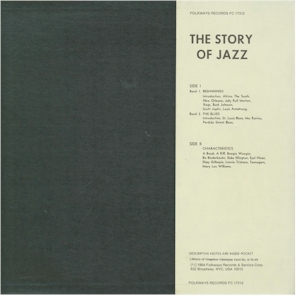
| Beginnings | Introduction, Africa, The South, New Orleans, Jelly Roll Morton, Rags, Bunk Johnson, Scott Joplin, Louis Amstrong (9:33) |
| The Blues | Introduction, St. Louis, Ma Rainey, Perdido Street Blues (6:53) |
| Characteristics | A Break, A Riff, Boogie Woogie, Bix Biederbecke, Duke Ellington, Earl Hines, Dizzy Gillespie, Lenny Tristano, Teenagers, Mary Lou Williams (15:08) |
|
|
|
|
|
more info: https://folkways.si.edu/langston-hughes/the-story-of-jazz/african-american-spoken-childrens-ragtime/music/album/smithsonian |
|
|

This website designed and maintained by Chwalik Internet Enterprises.
©2007-2026 Chwalik Internet Enterprises. All rights reserved.
|